Crown Thinningin Hatfield& Hertfordshire
Let light back into your garden and take weight out of a heavy canopy, while your tree keeps its natural shape and size.
Free quotation · Rated by customers on Google
- Georgie: NPTC / City & Guilds qualified
- £2m public liability insurance
- Licensed waste carrier
- Free quotations
- 24/7 emergency call-outs
Service overview
What crown thinning involves
Crown thinning is the selective removal of a proportion of a tree’s smaller inner branches. It reduces the density of the canopy so more light may filter through. Its suitability and effect depend on the individual tree. Unlike a reduction, thinning does not change the tree’s overall height or outline. Rosewood Tree Care Ltd carries out crown thinning for homes across Hatfield and Hertfordshire, with a free quotation and all cuttings removed afterwards.
Who it’s for
Crown thinning suits homeowners who like their tree but find it too heavy: lawns that struggle to grow in deep shade, rooms that feel dark, patios that never dry, or a canopy that looks dense and congested. It is often chosen for mature broadleaf trees such as oak, ash, sycamore, lime, beech and birch, as well as larger ornamental trees.
When you need it
Consider thinning when your garden is losing light, when the inside of the crown is crowded with crossing or rubbing branches, or when considering the condition of a tree in an exposed position. Thinning is not automatically appropriate for every mature tree or a guarantee against storm damage.
If it’s left too long
What happens when the work waits
A dense crown keeps getting denser. Without thinning, the issues it causes in your garden and in the tree itself tend to build year on year.
A dark, damp garden
Heavy shade stops grass growing, encourages moss and keeps patios and paths green and slippery. Rooms facing the tree stay dark for much of the year.
Exposure and structure
Wind exposure, tree condition and branch structure all affect risk. A dense crown alone does not establish that thinning is required or will prevent storm damage.
Rubbing and decay
Crossing branches rub through bark, creating wounds where decay can enter. Congested crowns also hold more deadwood.
Common mistakes we see
- Removing too much of the crown at once, which stresses the tree.
- Stripping all inner growth so only foliage at branch tips remains.
- Cutting large limbs instead of selecting smaller branches.
- Leaving stubs that cannot seal and invite decay.
- Confusing thinning with topping, which ruins a tree’s structure.
- Using unqualified help to work at height in the canopy.
Our process
How the job runs, step by step
- 01
Get in touch
Tell us about the tree and what you would like: more light, less weight or a tidier crown.
- 02
Assess the crown
We look at the tree’s species, health and structure to decide how much thinning is appropriate.
- 03
Free quotation
You receive a quotation explaining the work before anything is agreed.
- 04
Selective thinning
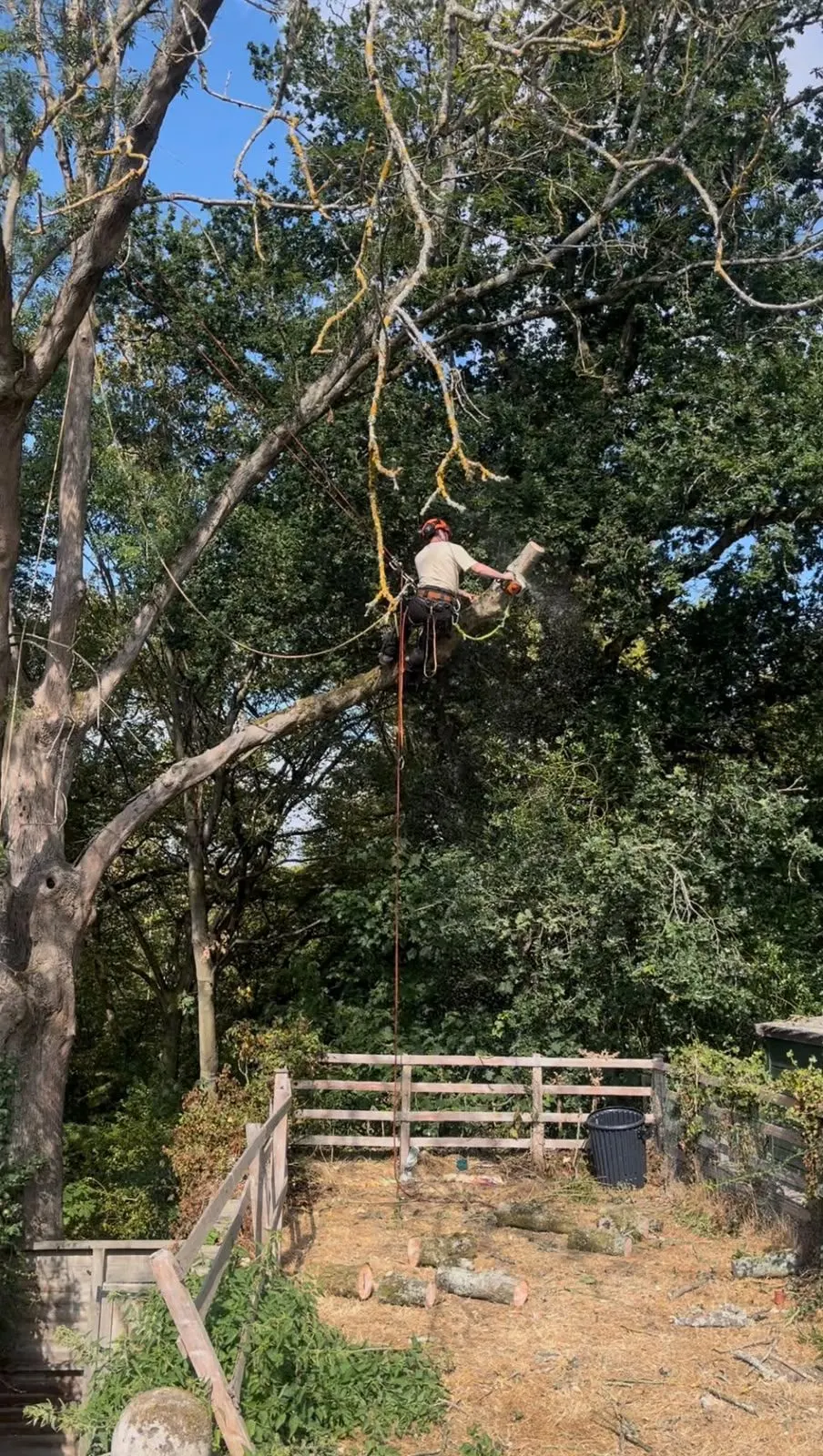
The team removes chosen branches evenly through the crown, along with deadwood and rubbing branches.
- 05
Clear up
All cuttings are removed from your property and the area is left tidy.
The result
What you get from the work
More light
Dappled light reaches lawns, borders and windows again, without losing the tree.
Tree-specific assessment
The amount and type of crown work should suit the tree’s structure and condition. Thinning should not be treated as a guarantee of storm resistance.
Natural shape kept
Height and outline stay the same, so the tree still looks like itself.
Healthier structure
Removing crossing, rubbing and dead branches reduces wounds and decay.
Better airflow
Improved air movement through the crown can help leaves dry faster after rain.
No clear-up for you
As a licensed waste carrier, we take all green waste away when the job is complete.
In detail
Crown thinning and related crown work
Crown thinning is one of several crown treatments. Often the best result comes from combining them. Here is how they differ and when each one is used.
How much is removed
Thinning is usually limited to a modest proportion of the living crown in any one visit, so the tree can continue to feed itself and recover. Exactly how much depends on species, age and vigour; older and stressed trees tolerate less.
Thinning vs reduction
Thinning works inside the canopy and leaves the size unchanged. Crown reduction cuts branch ends back to lower the height and spread. If your tree is simply too big for its space, reduction, or a combination of the two, may suit better.
Crown lifting
Lifting removes lower branches to raise the base of the crown. Combined with thinning it can transform light levels beneath a tree and give headroom over paths and driveways.
Crown cleaning
Cleaning removes dead, dying, diseased and broken branches. Any additional work should be discussed and explicitly agreed in the quotation, rather than assumed to be included with thinning.
Species considerations
Some trees respond better to thinning than others. Certain species bleed sap heavily when pruned in late winter and spring, so timing matters. We will advise on the right approach for your tree.
Protected trees
If a tree has a Tree Preservation Order or is in a conservation area, check with your local council before booking, as consent or notice is usually needed even for thinning.
What affects the cost of crown thinning
Every quotation is free and based on your job. These are the main factors that shape the price.
Access to the work
Wide side access, a clear driveway or an open front garden makes it quicker to move equipment and waste. Narrow passages, steps, steep slopes, glasshouses or tight back gardens mean more time carrying material by hand, and that time is reflected in the quotation. Let us know about access when you first get in touch so the quote is accurate.
Volume of green waste
Every job ends with the green waste removed from your property. More branches, foliage and timber means more chipping, loading and disposal. Conifers and evergreen hedges produce far more volume than people expect, so this is one of the bigger variables in any quotation.
Tree size and species
Larger and taller trees need more climbing time to thin evenly throughout the crown. Some species have denser branch structures than others, which also affects the time involved.
Combined crown work
Discuss whether any additional crown work is appropriate and can be included in the quotation. No extra technique or single-visit schedule should be assumed.
Nearby obstacles
Where branches overhang roofs, conservatories, greenhouses or neighbouring gardens, cut material may need to be lowered on ropes, which takes longer than letting it drop.
Crown Thinning across Hertfordshire
Trees respond differently to thinning. Not every mature tree needs repeat thinning, and excessive or unnecessary cutting can cause stress. Discuss the species, health, structure and objectives before planning any further work or a maintenance interval.
When you get in touch, it helps to tell us which part of the garden you want more light in, whether the tree overhangs a neighbour and whether there are any cables or structures nearby. Photographs taken from a couple of angles are useful too.
Large broadleaf trees such as oak, lime, sycamore and beech are common across Hatfield, Welwyn Garden City and the older parts of St Albans. Crown thinning lets homeowners keep these trees while bringing back light to gardens that have gradually become shaded.
Because many of these trees are mature or sit in conservation areas, it is worth checking with your local council before booking any crown work.
Your questions
Crown Thinning FAQs
What is crown thinning?
It is the selective removal of smaller branches throughout a tree’s canopy to reduce density, which may let in more light while retaining the tree’s overall height and outline; it does not guarantee improved stability.
How much does crown thinning cost?
The cost depends on the size and species of the tree, how much thinning it needs and access. We provide a free quotation after discussing the tree with you.
Will crown thinning harm my tree?
Carried out correctly and in moderation, thinning is a standard arboricultural practice. Over-thinning causes stress, which is why we tailor the amount to each tree.
How often should a tree be thinned?
It depends on the species and growth rate. Not every tree needs routine thinning. Discuss its condition and whether further work is appropriate before setting a cycle.
What is the difference between thinning and reduction?
Thinning reduces density inside the crown. Reduction makes the tree smaller overall. Some trees benefit from both.
How long does it take?
Timing depends on the tree, the amount of work and access. We will discuss an estimate with your quotation rather than promise a fixed completion time.
Do you remove the cuttings?
Yes. All green waste is completely removed from your property once the job is complete.
Do you offer crown thinning near me?
We are based in Hatfield and cover Hertfordshire, including Welwyn Garden City, St Albans, Hertford, Potters Bar, Harpenden, Stevenage and Ware.

Bring the light back into your garden
Keep the tree you love, without the shade and weight. Ask for a free quotation for crown thinning.
- Georgie: NPTC / City & Guilds qualified
- £2m public liability insurance
- Licensed waste carrier
- Free quotations
Prefer to read more first? Contact details