
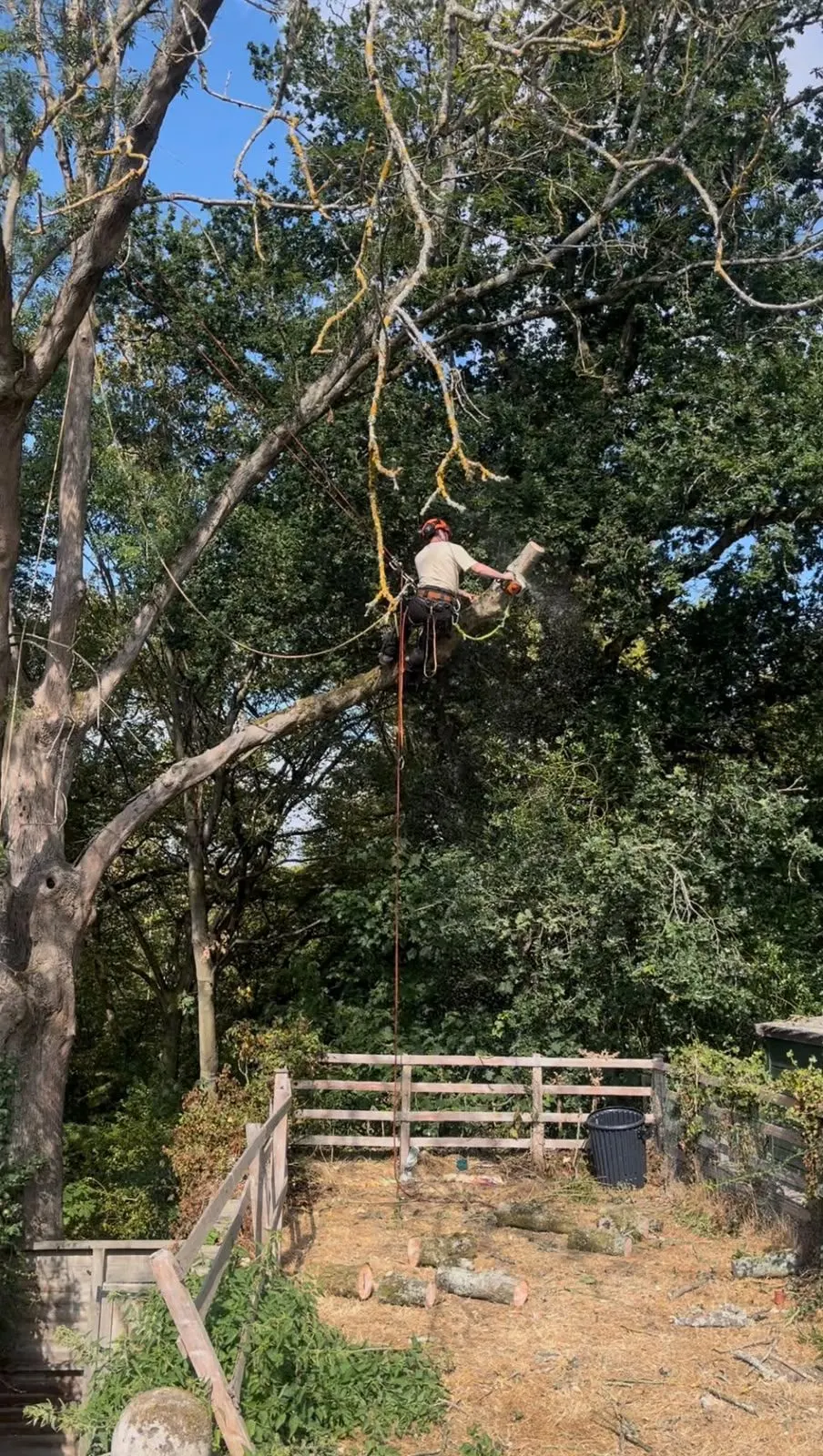
Tree Pollardingin Hatfield& Hertfordshire
Keep a suitable tree compact and manageable with planned, regular cutting back to established points, to help manage its size through an appropriate ongoing cutting cycle.
Free quotation · Rated by customers on Google
- Georgie: NPTC / City & Guilds qualified
- £2m public liability insurance
- Licensed waste carrier
- Free quotations
- 24/7 emergency call-outs
Service overview
What tree pollarding involves
Pollarding is a traditional pruning system in which a tree’s branches are cut back to the same points, known as pollard heads or knuckles, on a regular cycle. The tree responds by producing a flush of new shoots, which are removed again at the next visit. The result is a tree kept at a fixed, compact size. Rosewood Tree Care Ltd maintains existing pollards and advises on starting new ones for homes across Hatfield and Hertfordshire.
Who it’s for
Pollarding suits homeowners with species that respond well to it, such as willow, lime, plane and some others, in gardens or frontages where a full-sized tree would be too large. It is also for anyone who already has a pollarded tree that is due, or overdue, its next cut.
When you need it
Existing pollards need cutting back on a regular cycle, often every few years depending on species and growth. If the regrowth has become heavy, is shading the house or is reaching towards buildings and cables, it is time for the next cut. Starting a new pollard is best done while a tree is relatively young.
If it’s left too long
What happens when the work waits
An established pollard depends on being cut regularly. Missing cycles creates problems that are harder to correct later.
Heavy, weakly attached regrowth
Shoots from pollard heads keep thickening. Left too long, they become large, heavy limbs attached only at the knuckle and more prone to breaking.
Lost size control
The point of pollarding is a compact tree. Overdue pollards quickly start shading gardens and pressing against buildings again.
Harder recovery
The longer the gap, the bigger the cuts needed. Large cuts are more stressful for the tree and slower to seal.
Common mistakes we see
- Hard-pollarding a large mature tree for the first time.
- Confusing pollarding with topping any species.
- Cutting into or below the established pollard knuckles.
- Leaving years between cuts on an established pollard.
- Pollarding species that do not respond well to it.
- Leaving piles of cut stems for the homeowner to clear.
Our process
How the job runs, step by step
- 01
Get in touch
Tell us about the tree, whether it has been pollarded before and how big it has become.
- 02
Check suitability
We look at the species, age and condition to confirm pollarding is the right approach.
- 03
Free quotation
You receive a quotation for the work before any decision is made.
- 04
Cut back to the heads
Regrowth is removed back to the pollard points, without damaging the knuckles.
- 05
Clear away
All cut stems and green waste are removed from your property.
The result
What you get from the work
Ongoing size management
An appropriate pollarding cycle can help manage the size of a suitable tree. Regrowth and the next cutting interval depend on species and condition.
Space and light
Removing the regrowth brings light back into gardens and windows.
Lower risk of breakage
Cutting before shoots become heavy limbs reduces the chance of them failing.
Longer tree life
Well-maintained pollards can be long-lived, keeping mature trees in places that couldn’t otherwise hold them.
Predictable maintenance
A regular cycle makes it easy to plan and budget for future work.
Nothing left behind
As a licensed waste carrier we take all green waste away once the job is complete.
In detail
Understanding pollarding
Pollarding has a long history in Britain, originally used to produce a regular crop of wood above the reach of grazing animals. Today it is mostly used to keep trees compact in gardens and streets. Here is what you need to know.
Suitable species
Species that respond vigorously to cutting, such as willow, lime and plane, are commonly pollarded. Many other trees, including most conifers and birch, do not regrow reliably and should not be pollarded.
Starting a pollard
A new pollard is best started on a young tree with small branches, cutting at a chosen height. Over successive cuts, swollen pollard heads form at those points.
Maintaining an existing pollard
Established pollards are cut back to just above the knuckles on each cycle. The knuckles contain the tree’s stored energy and buds, so they must be preserved.
Lapsed pollards
Where a pollard has been left for many years, large cuts may cause stress. Discuss its condition and whether specialist assessment or a staged approach is needed; restoration is not automatically suitable or included.
Pollarding vs topping
Topping cuts a tree’s main stems indiscriminately, often on species and at sizes that cannot cope, causing decay and weak regrowth. Pollarding is a planned system started and maintained correctly.
Permissions
Pollarded trees can still be protected by a Tree Preservation Order or conservation area status. Check with your local council before work is booked.
What affects the cost of tree pollarding
Every quotation is free and based on your job. These are the main factors that shape the price.
Access to the work
Wide side access, a clear driveway or an open front garden makes it quicker to move equipment and waste. Narrow passages, steps, steep slopes, glasshouses or tight back gardens mean more time carrying material by hand, and that time is reflected in the quotation. Let us know about access when you first get in touch so the quote is accurate.
Volume of green waste
Every job ends with the green waste removed from your property. More branches, foliage and timber means more chipping, loading and disposal. Conifers and evergreen hedges produce far more volume than people expect, so this is one of the bigger variables in any quotation.
Time since the last cut
An established pollard cut on a regular cycle has thinner regrowth that is quick to remove. A lapsed pollard with years of thick growth takes much longer and produces far more waste.
Number of pollard heads
Trees with many heads, or tall pollards that need climbing to reach, take more time than lower, simpler trees.
Position of the tree
Pollards near roads, footpaths, roofs or cables need more careful lowering of material, which adds to the time on site.
Tree Pollarding across Hertfordshire
Pollarding is not the only way to keep a tree small. For trees that are not suited to it, or mature trees that have never been pollarded, a crown reduction or regular pruning may achieve a similar result with less stress. We can discuss the options and why we recommend one approach over another, so you can make an informed decision. Whatever is agreed, Georgie and the team carry out the work. Georgie holds NPTC / City & Guilds qualifications, Rosewood holds £2 million public liability insurance, and the green waste is completely removed when the job is done.
Because pollarding works on a cycle, it is worth planning ahead. Once your tree has been cut, we can let you know roughly when the next cut is likely to be needed, based on the species and how quickly it grows in your garden. Keeping to that cycle keeps each visit simpler and the tree in better condition.
If you are unsure whether your tree has been pollarded before, look for swollen knobbly points at the ends of the main branches. Those are the pollard heads, and they show where previous cuts were made. Send us a photograph and we can tell you more.
Pollarded limes, planes and willows are a familiar sight on older streets and in larger gardens across Hertfordshire. Many homeowners inherit pollards with a property and are unsure when they were last cut. We can look at the tree and tell you whether it is due.
Willows near ponds and streams are often pollarded to keep them compact, while limes and planes near houses are pollarded to manage their size and shade.
Your questions
Tree Pollarding FAQs
What is pollarding?
Pollarding is a pruning system where a tree’s branches are cut back to the same points on a regular cycle, keeping the tree at a compact, fixed size.
How much does pollarding cost?
It depends on the size of the tree, how much regrowth there is and access. We provide a free quotation after discussing the tree.
How often should a tree be pollarded?
Established pollards are usually cut every few years, depending on the species and how fast it grows. We will advise on a sensible cycle.
Can any tree be pollarded?
No. Some species respond very well, while others do not regrow reliably. We will tell you if pollarding is suitable for your tree.
Can you pollard a large mature tree?
Hard-pollarding a large mature tree for the first time can seriously damage it. A crown reduction is often more appropriate. We will advise honestly.
When is the best time to pollard?
Pollarding is often done in the dormant season, though this varies by species. We check for nesting birds during spring and summer.
Do you take away the cuttings?
Yes. All green waste is removed from your property when the job is complete.
Do you offer pollarding across Hertfordshire?
Yes. We are based in Hatfield and cover Welwyn Garden City, St Albans, Hertford, Potters Bar, Harpenden, Stevenage, Ware and the wider county.

Keep your tree the size you want
Find out whether pollarding suits your tree, and get a free quotation for the work.
- Georgie: NPTC / City & Guilds qualified
- £2m public liability insurance
- Licensed waste carrier
- Free quotations
Prefer to read more first? Contact details