Tree Pruning& Cutting Backin Hatfield
Get branches off the roof, away from the windows and back from the boundary, with cuts chosen to suit the tree’s condition and every cutting cleared away.
Free quotation · Rated by customers on Google
- Georgie: NPTC / City & Guilds qualified
- £2m public liability insurance
- Licensed waste carrier
- Free quotations
- 24/7 emergency call-outs
Service overview
What tree pruning involves
Tree pruning and cutting back means removing selected branches to control size, improve structure, clear obstructions or remove dead and damaged wood. Appropriate pruning can help manage growth and remove problematic branches. The response depends on species, condition, timing and the amount removed. Rosewood Tree Care Ltd prunes and cuts back trees for homes across Hatfield and Hertfordshire, from small ornamental and fruit trees to large mature trees overhanging houses and boundaries.
Who it’s for
Pruning is for anyone whose trees are starting to get in the way: branches touching the house, overhanging a neighbour’s garden, blocking a driveway, shading solar panels, reaching towards telephone cables, or growing over a path. It also suits fruit trees, such as apple and pear, that have become tall, tangled or unproductive.
When you need it
Call when branches reach the roof, gutters or windows, when deadwood is visible, after storm damage, or when a tree is growing faster than the space allows. Regular cutting back every few years is usually much easier and cheaper than waiting until major work is needed.
If it’s left too long
What happens when the work waits
Overhanging branches rarely stay where they are. Put off cutting back and the job, and the risk, gets bigger.
Damage to the house
Branches rubbing on tiles, gutters and fascias wear them away and block drainage, while leaves fill gutters and downpipes.
Boundary disputes
Branches overhanging a neighbour’s garden or driveway are a common source of friction, particularly when they drop debris or block light.
Dangerous deadwood
Dead branches can fall without warning, especially in wind, onto paths, cars and people below.
Common mistakes we see
- Cutting branches flush to the trunk, removing the branch collar.
- Leaving long stubs that die back and decay.
- Topping trees, which causes dense, weakly attached regrowth.
- Pruning too much in one go and stressing the tree.
- Tearing bark by cutting heavy limbs without undercutting first.
- Working off ladders with saws near the house.
Our process
How the job runs, step by step
- 01
Talk to us
Tell us which trees need attention and what you want cleared: roof, windows, boundary or path.
- 02
Agree the cuts
We look at the tree’s structure and explain which branches to remove and how far to cut back.
- 03
Free quotation
You receive a quotation for the agreed pruning before the work goes ahead.
- 04
Prune and cut back
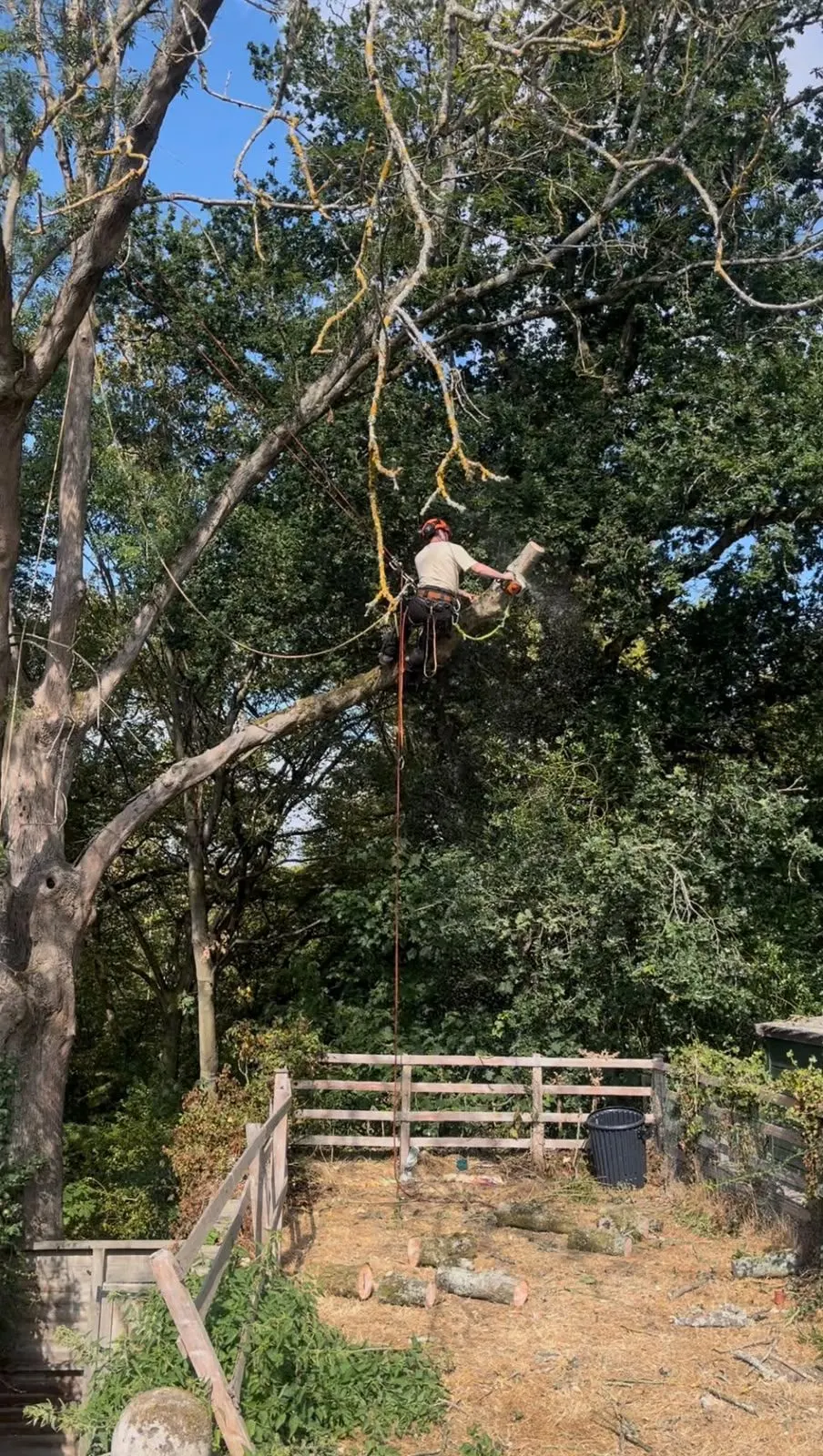
The team makes clean, correctly placed cuts, lowering larger branches carefully.
- 05
Tidy finish
All cuttings are removed and the garden is left clean and tidy.
The result
What you get from the work
Clear roofs and gutters
Branches are cut back from the house, reducing wear on roofs and gutters.
Room to move
Paths, driveways and parking spaces are cleared of low and overhanging growth.
Better neighbour relations
Overhanging growth is cut back to the boundary, removing a common source of complaint.
Safer trees
Dead, damaged and weak branches are removed before they fall.
Healthier growth
Correct cuts let the tree seal its wounds and grow in a balanced shape.
Everything removed
As a licensed waste carrier we take all green waste away when the work is complete.
In detail
Types of pruning we carry out
Pruning covers several different techniques. We choose the right one, or combination, for your tree and what you want to achieve.
Cutting back from buildings
Branches are pruned back to suitable points so they clear roofs, gutters, walls and windows by a sensible margin, allowing for regrowth before the next visit.
Boundary and overhang pruning
Overhanging branches are cut back to the boundary line where appropriate. Remember that branches belong to the tree’s owner, so it is worth talking to your neighbour first.
Deadwooding
Dead and dying branches are removed from the crown. This is one of the most effective ways to improve the safety of a mature tree.
Formative pruning
Young trees are pruned to develop a strong central structure and well-spaced branches, avoiding problems as they mature.
Fruit tree pruning
Apple, pear and plum trees benefit from regular pruning to keep them a manageable size, open up the centre and encourage healthy fruiting wood. Timing differs between species.
Timing and wildlife
Many trees can be pruned at most times of year, but some are best left at certain seasons. Nesting birds are protected, so we check for active nests during spring and summer before starting work.
What affects the cost of tree pruning
Every quotation is free and based on your job. These are the main factors that shape the price.
Access to the work
Wide side access, a clear driveway or an open front garden makes it quicker to move equipment and waste. Narrow passages, steps, steep slopes, glasshouses or tight back gardens mean more time carrying material by hand, and that time is reflected in the quotation. Let us know about access when you first get in touch so the quote is accurate.
Volume of green waste
Every job ends with the green waste removed from your property. More branches, foliage and timber means more chipping, loading and disposal. Conifers and evergreen hedges produce far more volume than people expect, so this is one of the bigger variables in any quotation.
How much is being removed
A light trim of a few branches is quicker than a full cut-back of a tree that has been left for many years. The amount of material removed is the main driver of time on site.
Working height
Branches that can be reached from the ground are quick to deal with. Work in the upper crown means climbing and rigging, which takes longer and needs more equipment.
Number of trees
Pruning several trees in one visit is usually more cost-effective than booking each one separately, as equipment is already on site.
Tree Pruning across Hertfordshire
A good pruning job should be hard to spot from a distance. The tree should look balanced and natural, with branches ending at healthy side shoots rather than blunt stumps. Up close, cuts should sit just outside the branch collar, the slightly swollen ring where a branch joins the trunk, so the tree can grow over the wound. If a tree in your garden has been badly pruned in the past, with stubs, topping or tearing, corrective pruning over one or more visits can often improve its shape and health. We will explain what is realistic for your tree when we look at it.
Pruning is most effective as regular maintenance. Cutting back a little every few years keeps branches clear of the house, keeps the tree in proportion and avoids the large wounds created when a tree that has been neglected for a decade suddenly needs heavy work. Smaller cuts seal more quickly and leave the tree looking natural.
When you contact us, describe which branches are causing problems, whether they overhang a neighbour or a road, and whether there are cables nearby. Photographs help us understand the job and give you a free quotation based on the agreed scope.
The supplied customer reviews include comments about tidy work. Alexandra Cartwright said we left it really tidy and reasonably priced; Paul Payne called it a fantastic, very tidy job.
Typical pruning jobs around Hatfield and Hertfordshire include cutting trees back from houses on closely spaced estates, reducing fruit trees in back gardens, and lifting crowns over driveways and pavements.
If you share a boundary, a quick word with your neighbour before work is booked helps avoid disagreements over overhanging branches and the cuttings that come from them.
Your questions
Tree Pruning FAQs
How much does tree pruning cost?
Cost depends on how many trees there are, their size, how much needs removing and access. We provide a free quotation after discussing your trees.
Can you cut back branches overhanging from next door?
Generally you can cut overhanging branches back to the boundary, but the cuttings belong to the tree’s owner and protected trees need council consent. We recommend talking to your neighbour first.
How often should trees be pruned?
It depends on the species and growth rate. Many garden trees benefit from attention every few years. We can advise on a suitable cycle.
When is the best time to prune?
Many trees can be pruned year-round, but some species are best pruned at particular times. We check for nesting birds during spring and summer.
Do you prune fruit trees?
Yes. We prune apple trees and other fruit trees to control size and improve structure. One of our customers, Rhys Manchee, described George’s work on his apple tree as well priced, timely and tidy.
Will pruning damage my tree?
Correct pruning, using proper cuts and removing only an appropriate amount, is a normal part of tree care. Poor techniques, such as topping, cause the damage.
Do you take away the cuttings?
Yes. All green waste is completely removed from your property when the job is complete.
Which areas do you cover for tree pruning?
We are based in Hatfield and cover Hertfordshire, including Welwyn Garden City, St Albans, Hertford, Potters Bar, Harpenden, Stevenage and Ware.

Get the branches off your roof
Tell us what needs cutting back. We will give you a free quotation, carry out the agreed work and remove all green waste on completion.
- Georgie: NPTC / City & Guilds qualified
- £2m public liability insurance
- Licensed waste carrier
- Free quotations
Prefer to read more first? Contact details